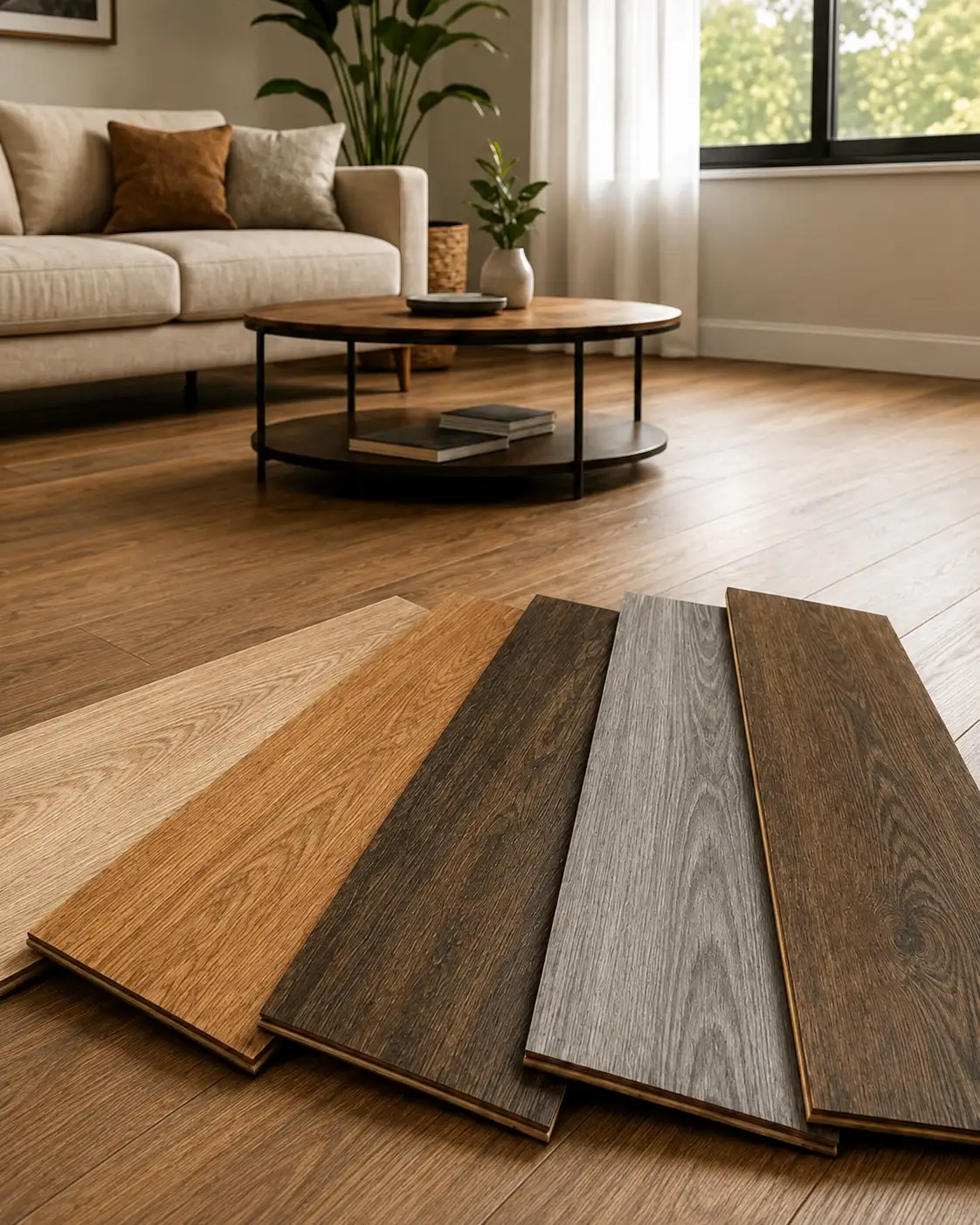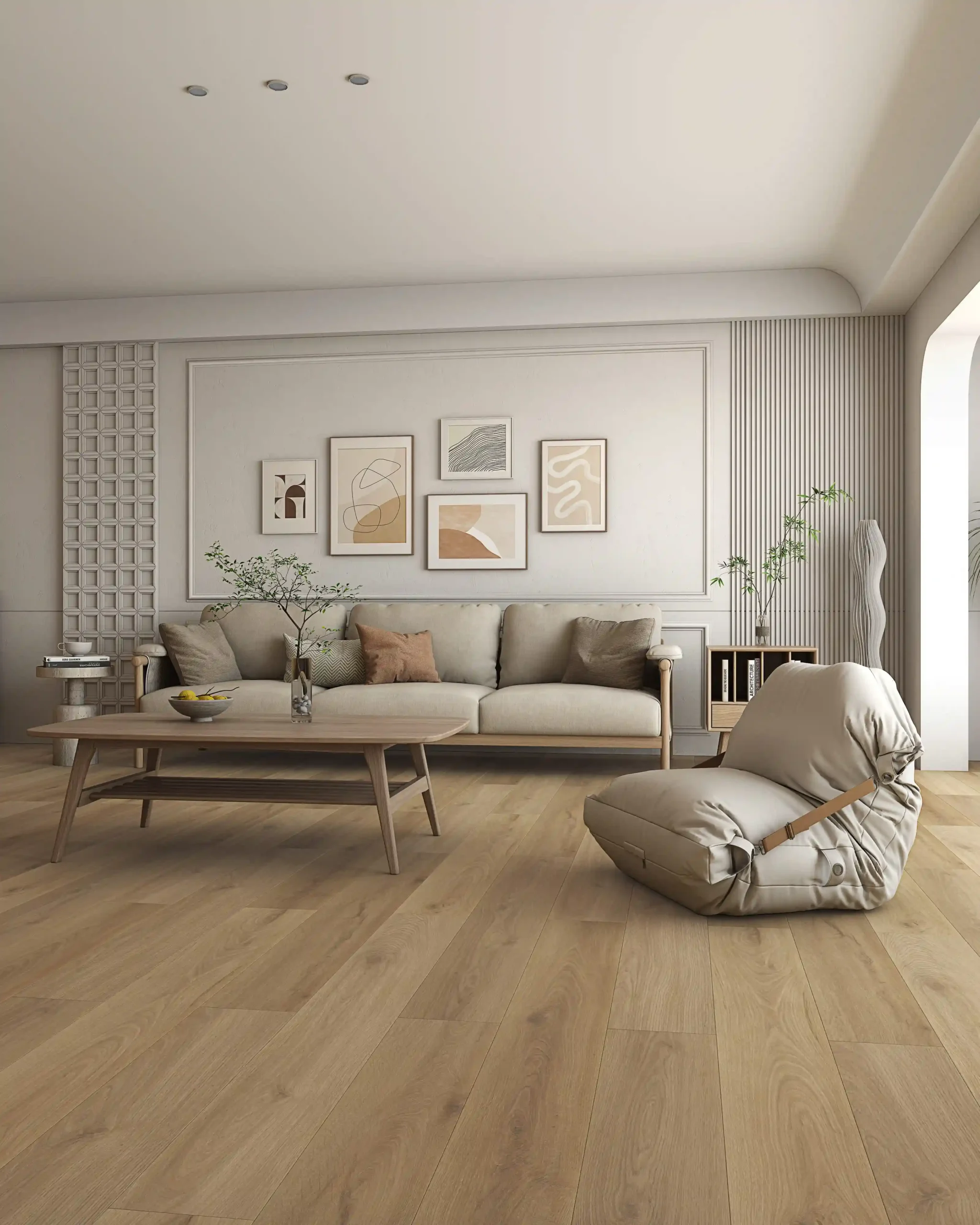
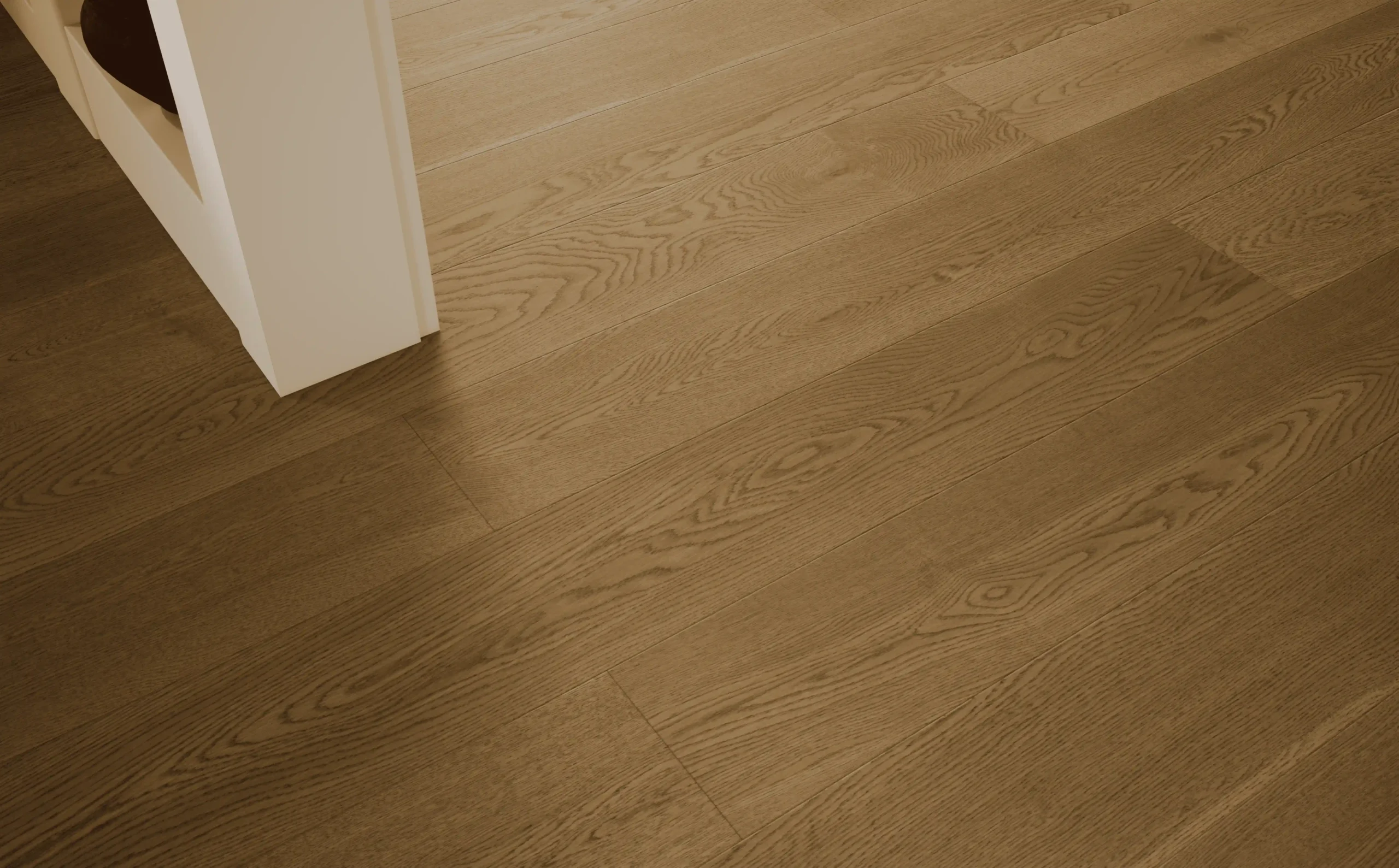

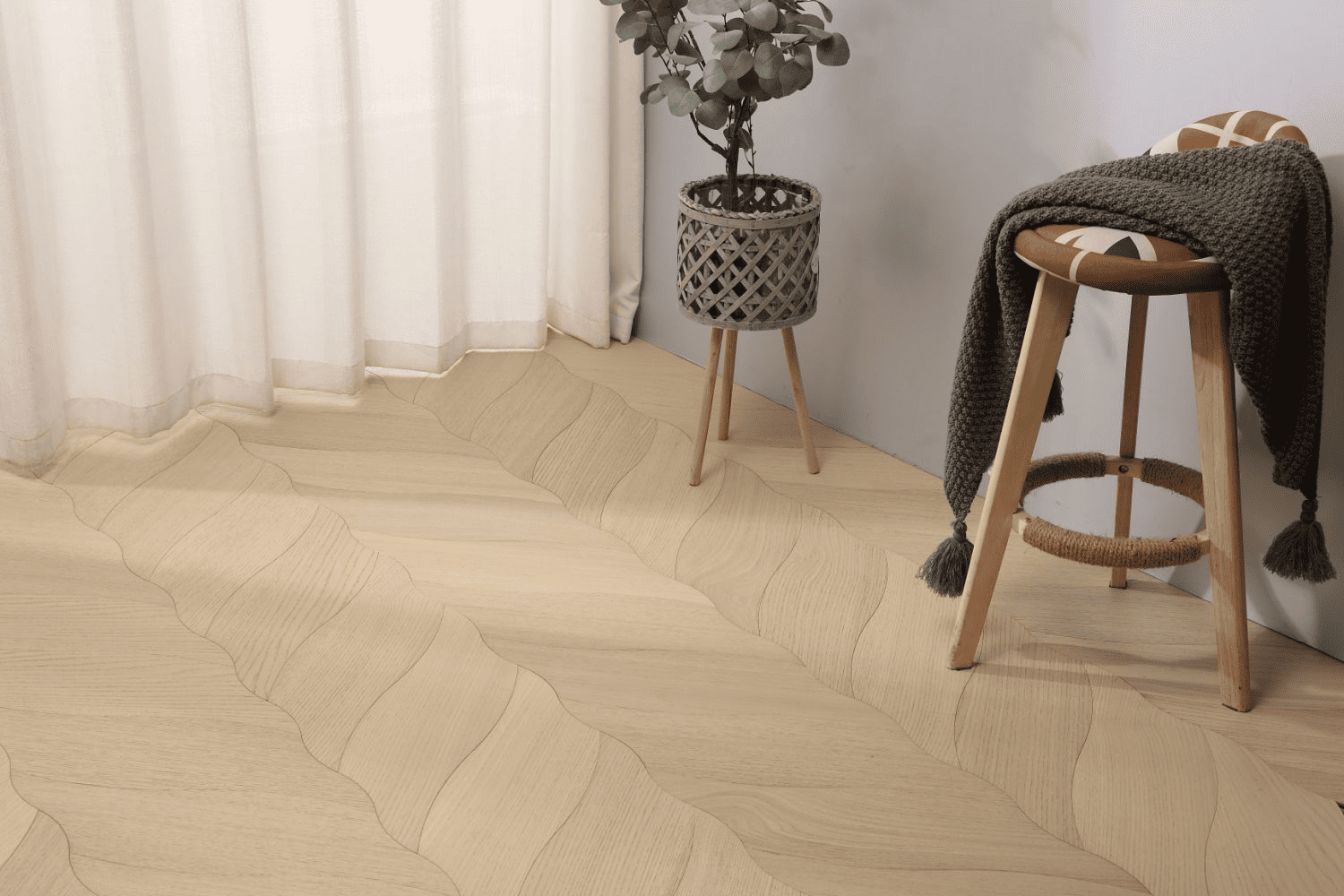


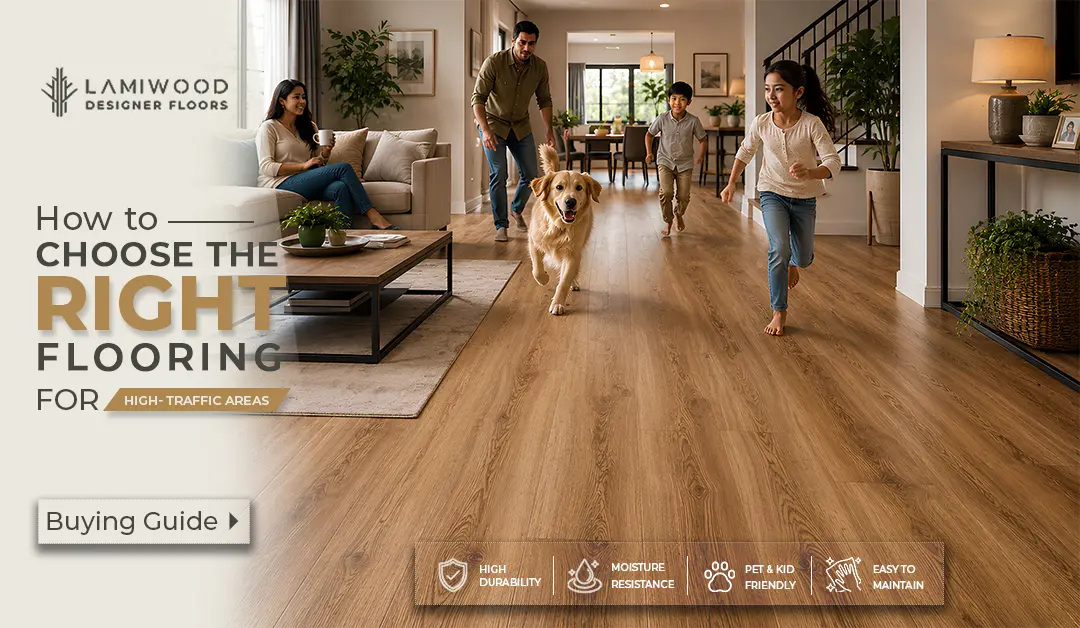
A floor doesn't really get tested when nobody is using it. It gets tested when the same hallway is crossed dozens of times a day, chairs are pulled across the living room, children are playing, pets are running around, and someone inevitably spills something.
During the monsoon, there is another challenge: wet footwear and moisture being brought indoors.
That is why choosing flooring for a high-traffic area should go beyond colour, pattern or even thickness. A floor may look beautiful, but what matters over the years is how well its surface, core and construction cope with everyday use.
So, what should you actually check before choosing flooring for a busy home, office or project?
What Is the Best Flooring for High-Traffic Areas?
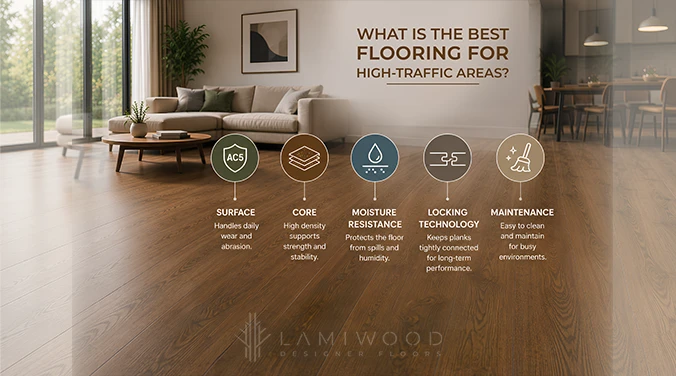
There isn't one specification that automatically makes a flooring product the best choice for every high-traffic space.
For laminate flooring, a durable abrasion rating such as AC5 is an important consideration. But it is only part of the picture. Core density, core construction, moisture resistance, locking technology, and maintenance requirements also influence how a floor performs.
Think of it this way: the surface has to handle wear, the core has to support the plank, and the construction as a whole has to suit the environment.
The right flooring is therefore the one whose specifications match the way the space will actually be used.
What Actually Makes a Floor Suitable for High Traffic?
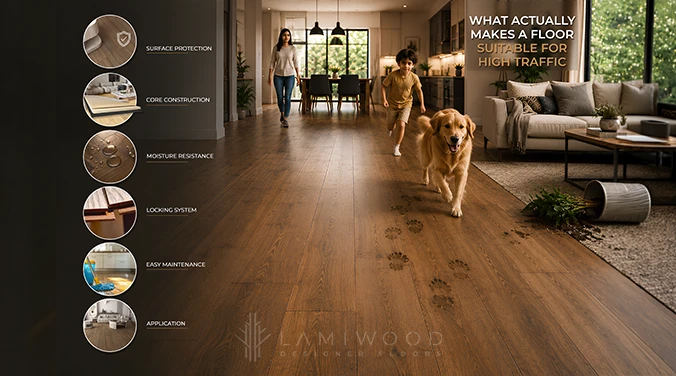
High traffic doesn't affect flooring in just one way.
Repeated footsteps create abrasion. Furniture can place concentrated pressure on small areas. Dirt and grit brought in through footwear can act like tiny abrasives when repeatedly walked over. Spills introduce moisture, while frequent cleaning adds another form of exposure.
When comparing flooring, look at several things together:
- Surface protection: How well is the top layer designed to withstand everyday wear?
- Core construction: What is inside the plank, and how stable is it?
- Moisture resistance: How does the flooring respond to spills and moisture?
- Locking system: How securely do the planks connect?
- Maintenance: How easy is it to keep the surface clean?
- Application: Is the product appropriate for the space where it will be installed?
The goal isn't to find the floor with the biggest number on the specification sheet. It is to find the combination of specifications that makes sense for the space.
Does AC Rating Tell You How Durable a Floor Is?
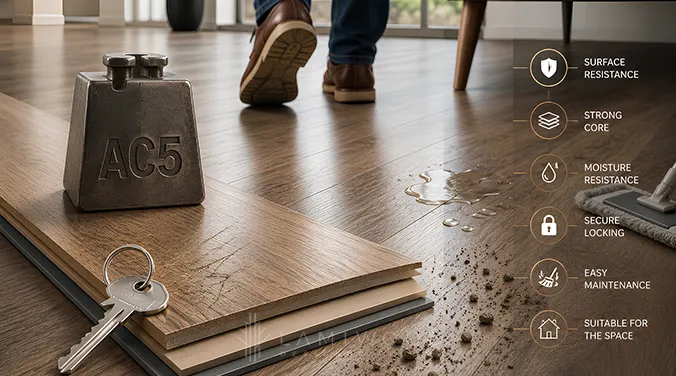
AC rating is one of the first specifications worth checking when comparing laminate flooring for a busy area.
The AC rating relates to the abrasion resistance of the flooring's protective surface. In simple terms, it indicates how well the surface is designed to withstand repeated wear.
Lamiwood's Essential Laminated Flooring and Hybrid Laminated Flooring ranges feature an AC5-grade protective layer designed to resist scratches, dents, and everyday wear.
But there is an important distinction here.
AC5 does not mean scratch-proof.
Dragging heavy furniture across the floor, allowing grit to accumulate, or using unsuitable cleaning methods can still affect the surface. Even highly wear-resistant flooring benefits from sensible maintenance.
So, use the AC rating as an important indicator of surface durability, but don't use it as the only measure of the floor's overall performance.
Why Does Core Density Matter in High-Traffic Flooring?
The surface gets most of the attention because that's what you see. The core, however, plays a major role in the structure of the plank.
In laminate flooring, the core contributes to the plank's strength and dimensional stability. This becomes particularly relevant when flooring is exposed to changes in temperature and humidity or the repeated stresses of everyday use.
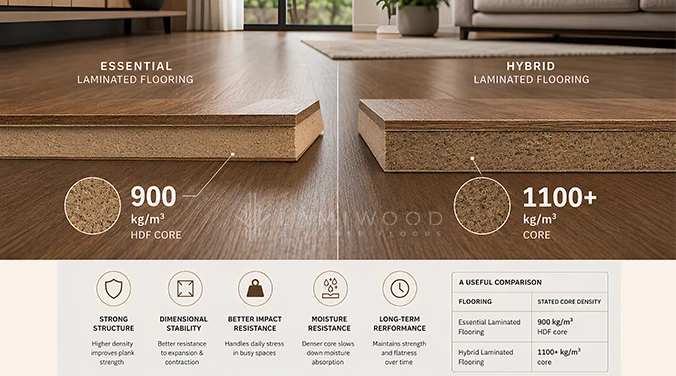
Lamiwood's Essential Laminated Flooring uses an HDF core with a stated density of 900 kg/m³, while its Hybrid Laminated Flooring uses a core with a density above 1100 kg/m³.
A useful comparison
| Flooring | Stated core density |
|---|---|
| Essential Laminated Flooring | 900 kg/m³ HDF core |
| Hybrid Laminated Flooring | 1100+ kg/m³ core |
These figures show that the two products use different core constructions and are designed around different performance characteristics. They should therefore be evaluated according to where and how the flooring will be used, rather than assuming that core density alone determines which product is better.
This is an important point when comparing flooring: a specification only becomes useful when you understand what it means in the context of the entire product.
Know More: HDF Laminate Flooring? Importance And Advantages
Is a Thicker Floor Automatically More Durable?
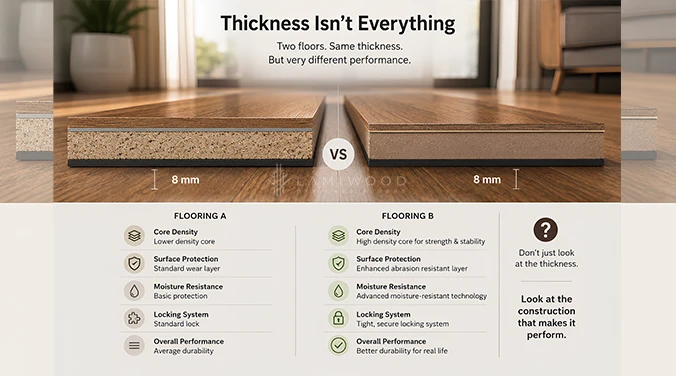
Not necessarily.
Thickness can influence how a floor feels underfoot and may be relevant to installation and subfloor conditions. But thickness alone doesn't tell you how well a floor will resist abrasion, moisture, or dimensional movement.
Imagine two flooring products that are both 8 mm thick. One could have a different core density, surface construction, moisture-resistance technology, or locking system from the other.
Their thickness is the same. Their overall construction isn't.
So instead of asking only:
"How thick is the flooring?"
also ask:
"What is the floor made of, and how is it constructed?"
That question gives you a much better basis for comparing products that may look almost identical once installed.
Know More: Does Flooring Thickness Really Matter? Density vs. Thickness Explained
How Important Is Moisture Resistance in a Busy Space?
More important than many buyers initially realise.
Consider an entrance during the monsoon. Wet shoes come inside. Someone spills a drink in the living room. A damp mop is used after a busy day. These aren't unusual situations, particularly in homes where the floor sees constant activity.
Moisture resistance therefore deserves attention alongside surface durability.
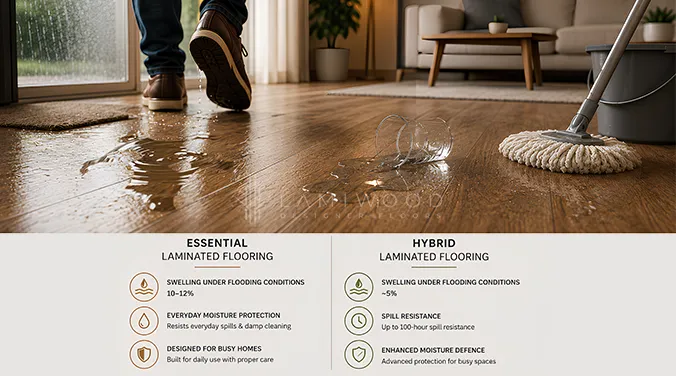
Lamiwood's Essential Laminated Flooring is specified to swell by around 10–12% under flooding conditions, while its Hybrid Laminated Flooring is specified with around 5% swelling and up to 100-hour spill resistance.
These specifications demonstrate why it is useful to look beyond a simple "water resistant" label and understand the stated performance of a product.
At the same time, moisture resistance should not be treated as a reason to leave standing water on the floor. Spills should still be cleaned promptly, and installation and care instructions should be followed.
Know more: Why Core Density Matters for Moisture-Resistant Flooring
Can the Locking System Affect Long-Term Flooring Performance?
The locking system is easy to overlook because you don't see it once the flooring has been installed.
But it plays an important role in how individual planks connect.
A properly engineered locking system is designed to create a secure connection between planks and help minimise unwanted movement and gaps.
Lamiwood's Essential Laminated Flooring uses Uniclick and Valinge 2G locking systems, designed to provide secure plank connections and help prevent gaps and movement.
Of course, the locking system isn't the only factor that determines installation performance. Subfloor preparation, installation quality, and environmental conditions matter too.
Still, it is a specification worth checking, particularly for areas where flooring will experience repeated daily use.
Know More: What Causes Gaps in Wooden Flooring and How to Prevent Them
How Can Maintenance Affect the Life of High-Traffic Flooring?
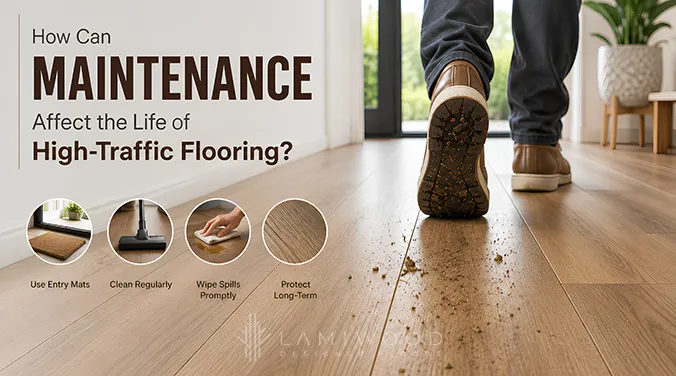
A durable floor still needs sensible maintenance. In fact, high-traffic areas make maintenance even more important because dirt, grit, and spills are more likely to come into contact with the surface.
Fine sand and grit carried indoors on footwear can contribute to surface abrasion when repeatedly walked over. A simple entrance mat, regular sweeping or vacuuming, and prompt removal of spills can help reduce unnecessary wear.
Even small design details can influence how easy a floor is to maintain.
Lamiwood's Essential Laminated Flooring uses 0.5 mm V-grooves, designed to create narrower grooves that are easier to clean and less likely to collect dust and debris compared with wider groove profiles.
This matters because high-traffic flooring isn't only about surviving footfall. It also needs to be practical to live with every day.
The product provides the performance characteristics; good maintenance helps preserve them.
What Is the Biggest Mistake People Make When Choosing High-Traffic Flooring?
Choosing based on appearance alone.
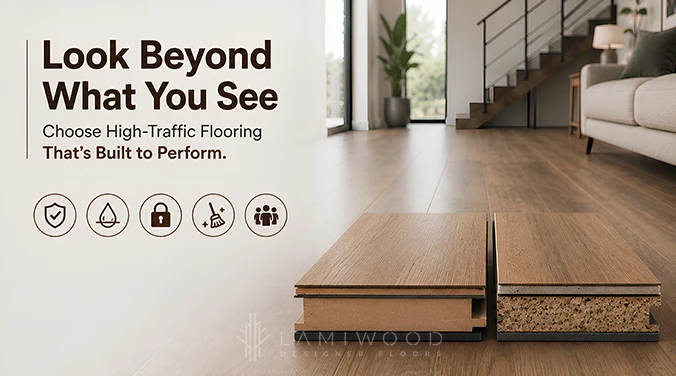
The colour and wood grain are usually the first things people notice, and there is nothing wrong with wanting a floor that looks beautiful. But appearance tells you very little about how the floor is constructed.
Before making a decision, ask:
- What is the core made of?
- What is its density?
- What is the AC rating?
- How does the flooring handle moisture?
- What locking technology does it use?
- How easy is it to maintain?
- Is it suitable for the intended application?
Two floors can look remarkably similar from the top while having very different specifications underneath.
That is why one of the most useful comparisons often starts below the surface.
Know More: Ultimate Guide to Choosing the Perfect Wooden Floors
What Should You Look for in Flooring for Different High-Traffic Areas?
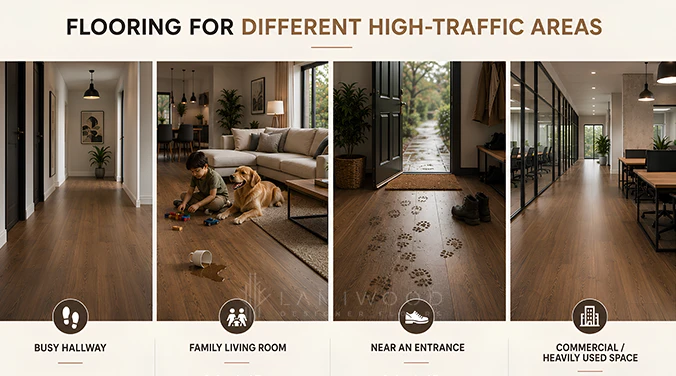
Not every busy space puts the same kind of pressure on flooring.
What should you look for in a busy hallway?
Hallways often experience repeated foot traffic along the same route. Abrasion resistance and a secure plank connection become particularly important.
What should you look for in a family living room?
A family living room may have furniture movement, children, pets, and occasional spills. A combination of surface durability, moisture resistance, stability, and easy maintenance can make sense.
For example, imagine a living room where dining chairs are pulled back and forth every day, children play on the floor, and drinks are occasionally knocked over. In that situation, looking at surface protection alone isn't enough. Moisture performance and ease of maintenance matter too.
What should you look for near an entrance?
Entrance areas are more likely to encounter dirt and moisture brought in from outside. Along with surface durability, moisture resistance deserves particular attention.
What should you look for in a commercial or heavily used space?
Don't assume that a residential specification is automatically suitable for every commercial application. Check the product's intended use, abrasion rating, construction, warranty, and manufacturer's recommendations.
The key is to match the flooring specification to the actual conditions of the space.
Which Flooring Specifications Should You Compare Before Buying?
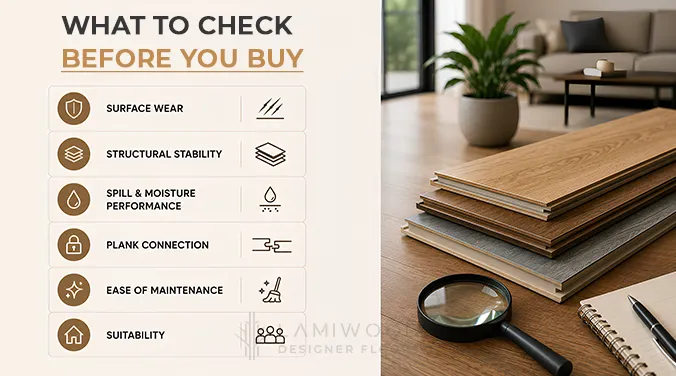
When comparing different flooring options, this simple framework can help:
| What you want to evaluate | What to check |
|---|---|
| Surface wear | AC rating and protective layer |
| Structural stability | Core density and construction |
| Spill and moisture performance | Moisture resistance and stated swelling performance |
| Plank connection | Locking system |
| Ease of maintenance | Groove profile and surface finish |
| Suitability | Intended application and manufacturer's recommendations |
This gives you a more meaningful comparison than simply asking which floor is thicker, cheaper, or more attractive.
Know More: How to Identify Good Quality Wooden Flooring in Just 5 Minutes
Is the Most Expensive Flooring Always the Best Choice?
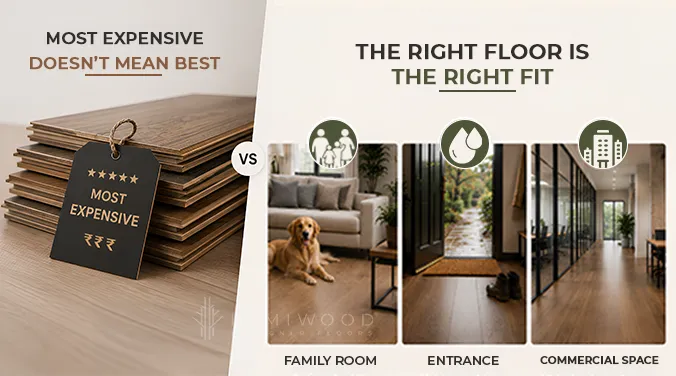
Not necessarily.
A higher price doesn't automatically make a flooring product better suited to a particular space.
A busy family room may require a different combination of features from a commercial corridor. An entrance may place greater emphasis on moisture resistance, while another room may place greater emphasis on surface durability and maintenance.
The right question isn't:
"Which is the most expensive flooring?"
It is:
"Which flooring has the specifications that make sense for this particular space?"
That gives you a much better basis for comparing products that may look similar but are built differently.
So, How Do You Choose Flooring for a High-Traffic Area?
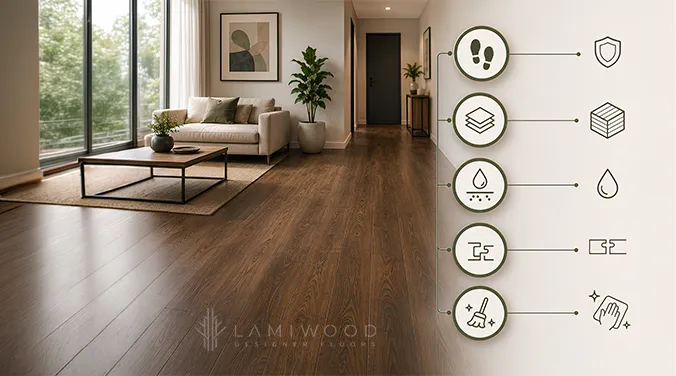
Start with how the space is actually going to be used.
For frequent foot traffic, check the AC rating and protective surface. For structural stability, look at the core construction and density. For areas exposed to spills, examine the moisture-resistance specifications. For installation stability, consider the locking system. And for busy households, don't overlook maintenance.
The best wood flooring for a high-traffic area isn't necessarily the thickest, the most expensive, or the one with the biggest number on the brochure. It is the one whose surface, core, moisture performance and construction are suited to the demands of the space.
Look beyond the colour. Look beneath the surface. That's where much of the real difference begins.
For a free consultation, reach out at 91+9999500117 Or drop us an email at [email protected]