


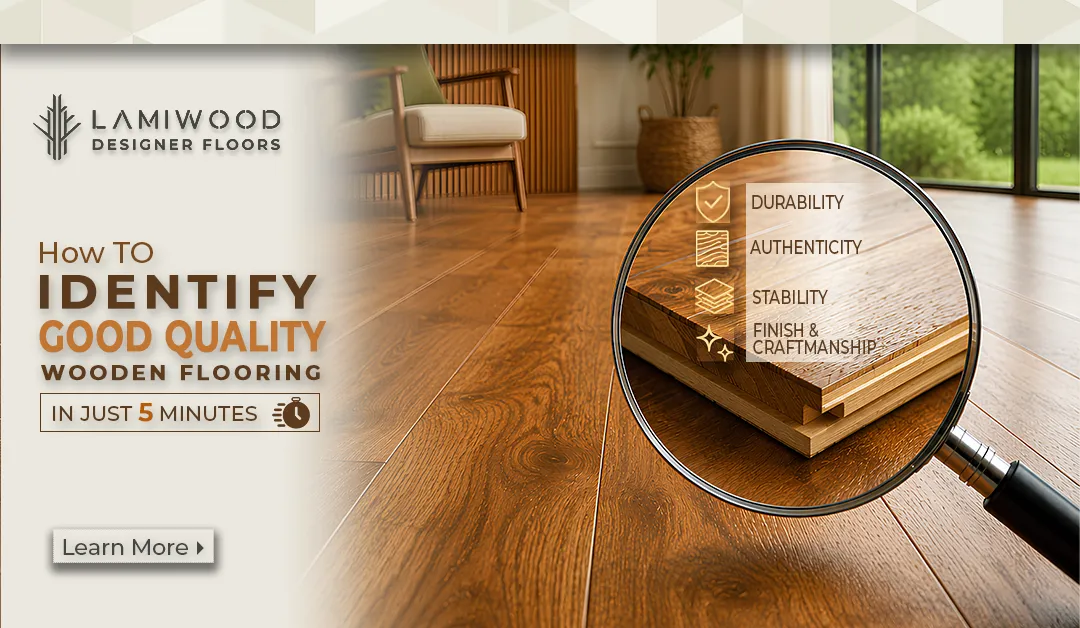
What If I Told You That Five Minutes Could Save You Years of Regret?
Have you ever noticed something strange?
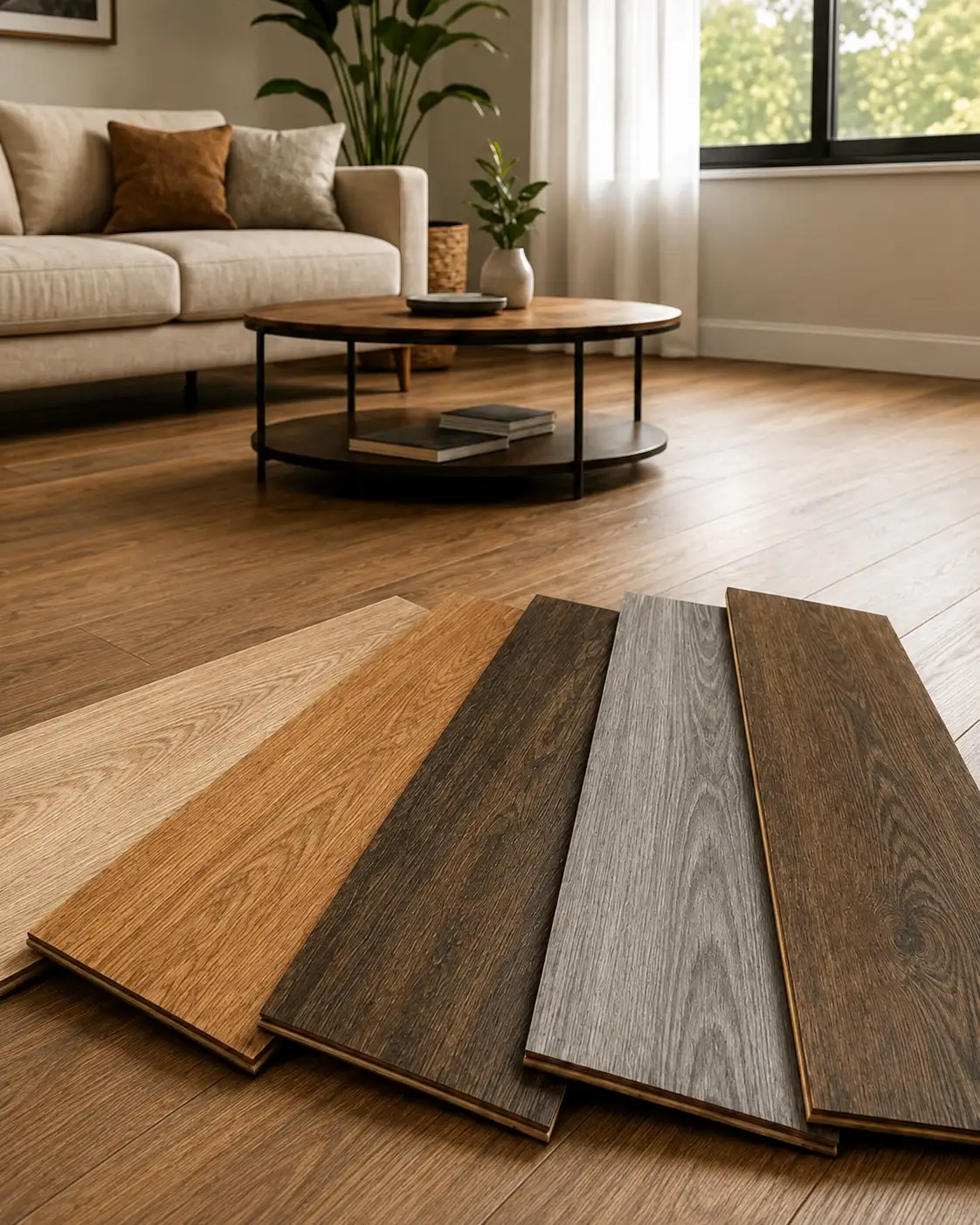
Two wooden floors can look almost identical.
The same shade.
The same wood texture.
Almost the same price.
Yet...
One floor stays beautiful for years.
The other starts swelling after a few monsoons.
Why does this happen?
Because what makes wooden flooring good quality isn't always visible.
And unfortunately, this is where many homeowners make a costly mistake.
They spend hours choosing the color.
They compare shades, textures, and finishes.
But they spend less than five minutes understanding what actually makes flooring durable.
Ironically...
Those five minutes are often the most important part of the buying process.
Because the truth is, you only need answers to a handful of questions to identify quality flooring.
And asking those questions takes less time than ordering a cup of coffee.
Let's go through them together.
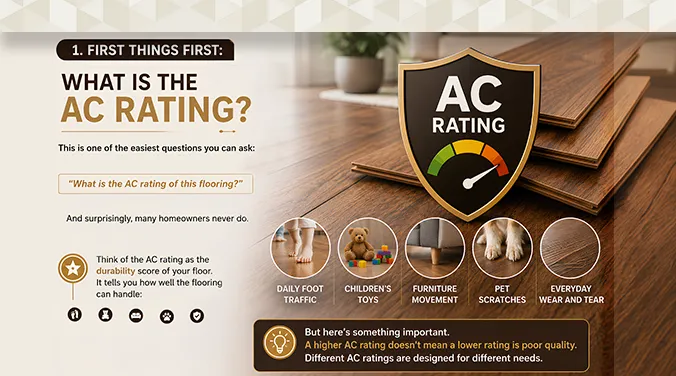
1. First Things First: What Is the AC Rating?
This is one of the easiest questions you can ask:
"What is the AC rating of this flooring?"
And surprisingly, many homeowners never do.
Think of the AC rating as the durability score of your floor.
It tells you how well the flooring can handle:
- Daily foot traffic
- Children's toys
- Furniture movement
- Pet scratches
- Everyday wear and tear
But here's something important.
A higher AC rating doesn't mean a lower rating is poor quality.
Different AC ratings are designed for different needs.
Which AC Rating Should You Choose?
- AC3 – Ideal for bedrooms, guest rooms, and spaces with light to moderate use.
- AC4 – Suitable for living rooms, busy households, and light commercial areas.
- AC5 – Designed for high-traffic homes and commercial spaces where extra durability is required.
The goal isn't to buy the highest AC rating.
The goal is to choose flooring that matches your lifestyle.
And honestly...
That's a much smarter decision.
2. The One Question I Personally Always Recommend Asking
If I were buying wooden flooring today, this would probably be one of my first questions:
"What is the density of the flooring core?"
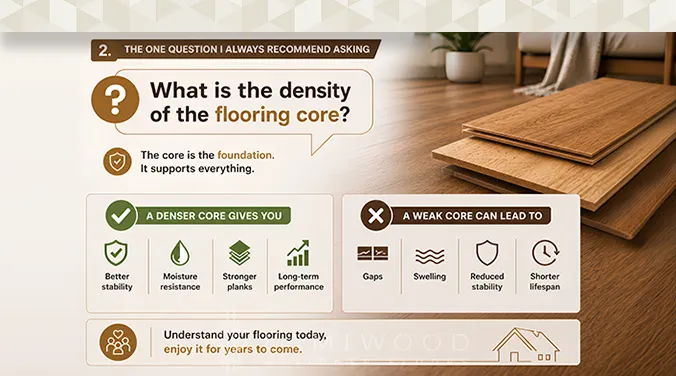
Because the core is the hidden hero of wooden flooring.
Think of it like the foundation of a house.
You don't see it every day.
But it supports everything.
A stronger and denser core generally provides:
- Better dimensional stability
- Improved moisture resistance
- Stronger plank construction
- Better long-term performance
On the other hand, a weak core may contribute to:
- Gaps between planks
- Reduced stability
- Swelling in humid conditions
- A shorter lifespan
Here's what I've noticed over the years:
Homeowners who spend a few extra minutes understanding the construction of their flooring are usually the happiest with their decision years later.
3. Here's a Simple Trick Most Buyers Never Try: Lift the Sample
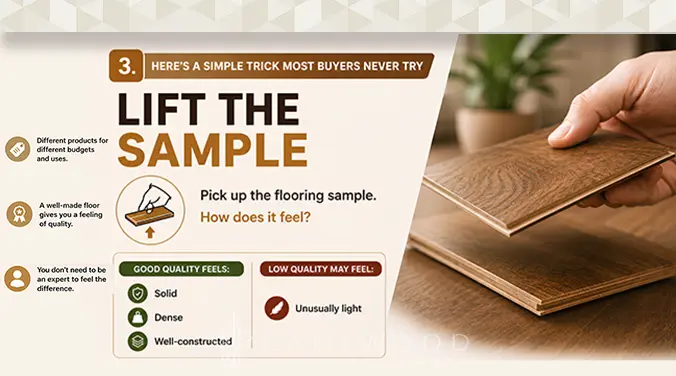
This sounds incredibly simple.
But it can tell you a lot.
Pick up the flooring sample.
How does it feel?
Does it feel:
- Solid?
- Dense?
- Well-constructed?
Or does it feel unusually light?
Different flooring products are designed for different budgets and applications.
However, a well-made floor often gives you a feeling of quality the moment you hold it.
It's a bit like holding a solid wooden door versus a hollow one.
You don't need to be an expert to feel the difference.
4. Can the Flooring Handle Real Indian Homes?
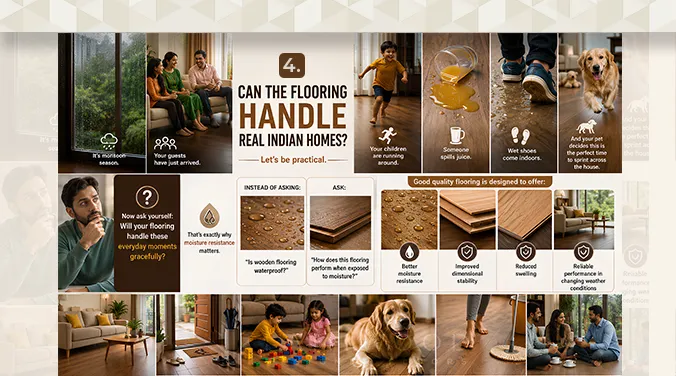
Let's be practical.
Indian homes aren't showrooms.
Imagine this.
It's monsoon season.
Your guests have just arrived.
Your children are running around.
Someone spills juice.
Wet shoes come indoors.
And your pet decides this is the perfect time to sprint across the house.
Now ask yourself:
Will your flooring handle these everyday moments gracefully?
That's exactly why moisture resistance matters.
Instead of asking:
"Is wooden flooring waterproof?"
Ask:
"How does this flooring perform when exposed to moisture?"
Good quality flooring is designed to offer:
- Better moisture resistance
- Improved dimensional stability
- Reduced swelling
- Reliable performance in changing weather conditions
Because beautiful flooring should be ready for real life.
5. Here's a Simple Water Test Many Experienced Buyers Try
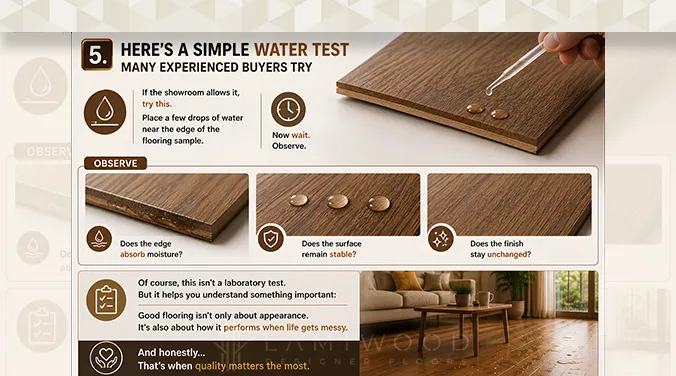
If the showroom allows it, try this.
Place a few drops of water near the edge of the flooring sample.
Now wait.
Observe.
- Does the edge absorb moisture?
- Does the surface remain stable?
- Does the finish stay unchanged?
Of course, this isn't a laboratory test.
But it helps you understand something important:
Good flooring isn't only about appearance.
It's also about how it performs when life gets messy.
And honestly...
That's when quality matters the most.
6. Does It Feel Like Real Wood?
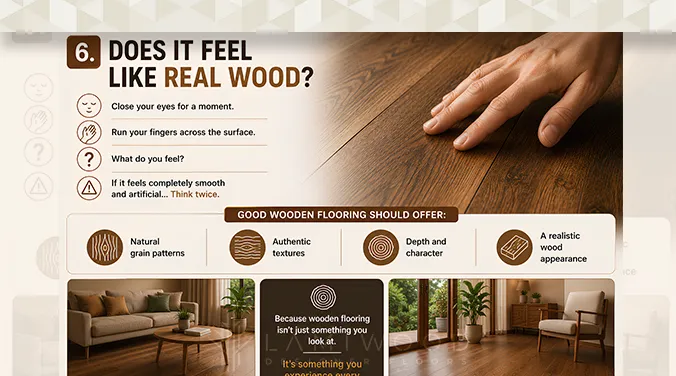
Close your eyes for a moment.
Run your fingers across the surface.
What do you feel?
If it feels completely smooth and artificial...
Think twice.
Good wooden flooring should offer:
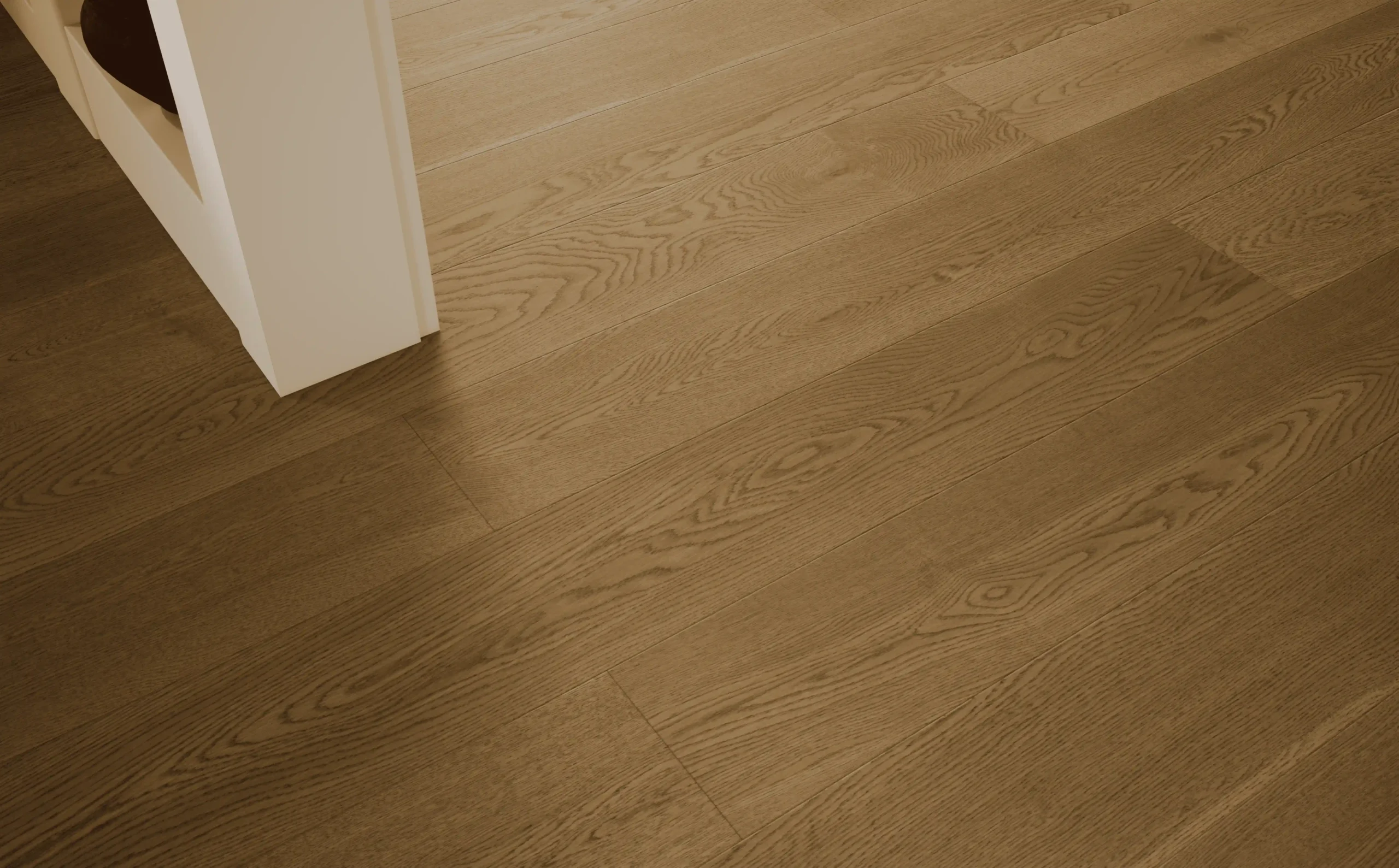
- Natural grain patterns
- Authentic textures
- Depth and character
- A realistic wood appearance
Because wooden flooring isn't just something you look at.
It's something you experience every single day.
7. Don't Overlook the Locking System
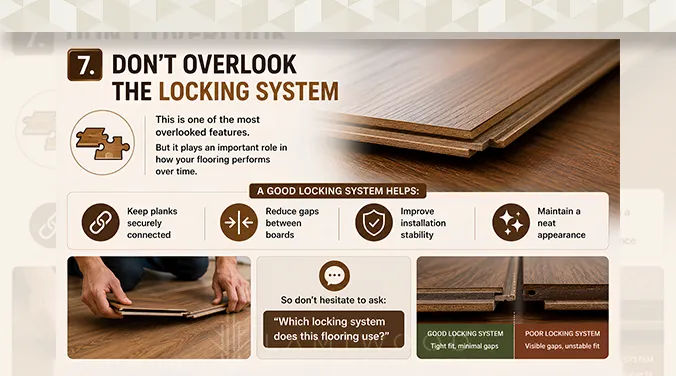
This is one of the most overlooked features.
But it plays an important role in how your flooring performs over time.
A good locking system helps:
- Keep planks securely connected
- Reduce gaps between boards
- Improve installation stability
- Maintain a neat appearance
So don't hesitate to ask:
"Which locking system does this flooring use?"
Sometimes the smallest details make the biggest difference years later.
Read Also: Valinge vs Uniclic vs Tongue & Groove: Pros, Cons, and Key Differences
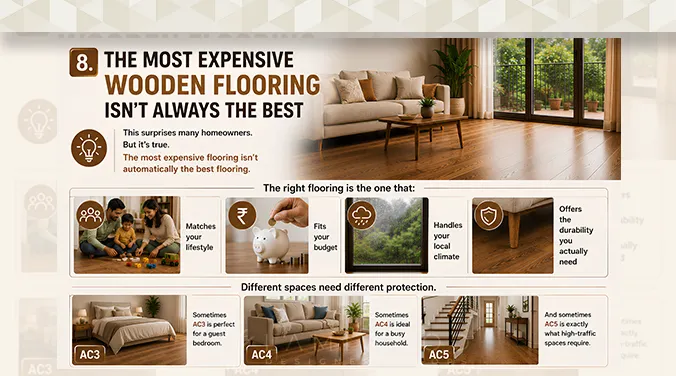
8. The Most Expensive Wooden Flooring Isn't Always the Best
This surprises many homeowners.
But it's true.
The most expensive flooring isn't automatically the best flooring.
The right flooring is the one that:
- Matches your lifestyle
- Fits your budget
- Handles your local climate
- Offers the durability you actually need
Sometimes AC3 is perfect for a guest bedroom.
Sometimes AC4 is ideal for a busy household.
And sometimes AC5 is exactly what high-traffic spaces require.
The goal isn't to buy the most expensive floor.
The goal is to buy the smartest one.
What Would I Personally Check If I Were Buying Wooden Flooring Today?
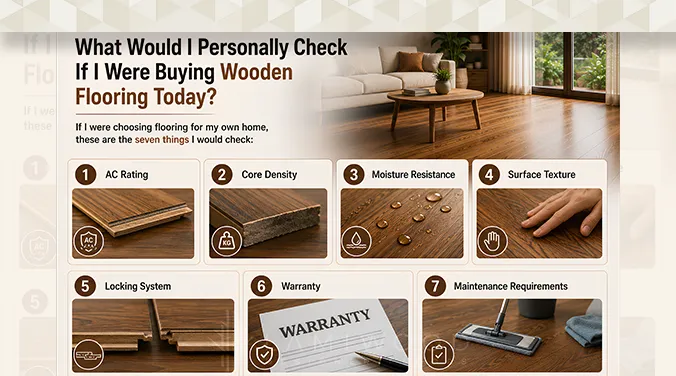
If I were choosing flooring for my own home, these are the seven things I would check:
- AC Rating
- Core Density
- Moisture Resistance
- Surface Texture
- Locking System
- Warranty
- Maintenance Requirements
Because beautiful flooring is easy to find.
Reliable flooring is not.
How to Choose the Right Wooden Flooring for Your Lifestyle
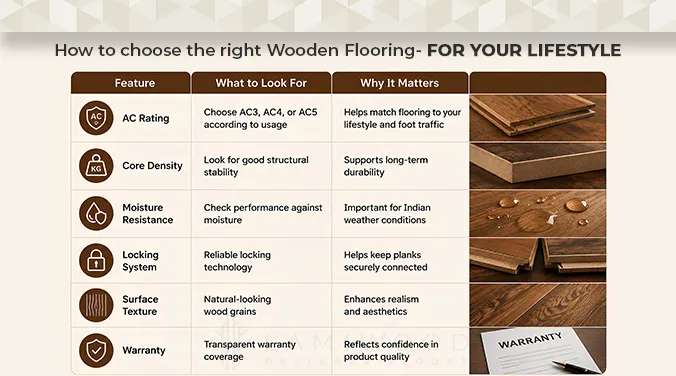
| Feature | What to Look For | Why It Matters |
|---|---|---|
| AC Rating | Choose AC3, AC4, or AC5 according to usage | Helps match flooring to your lifestyle and foot traffic |
| Core Density | Look for good structural stability | Supports long-term durability |
| Moisture Resistance | Check performance against moisture | Important for Indian weather conditions |
| Locking System | Reliable locking technology | Helps keep planks securely connected |
| Surface Texture | Natural-looking wood grains | Enhances realism and aesthetics |
| Warranty | Transparent warranty coverage | Reflects confidence in product quality |
Remember:
The right flooring isn't necessarily the most expensive one.
It's the one that fits your home beautifully and performs well for years.
5 Mistakes I Wish Every Homeowner Avoided
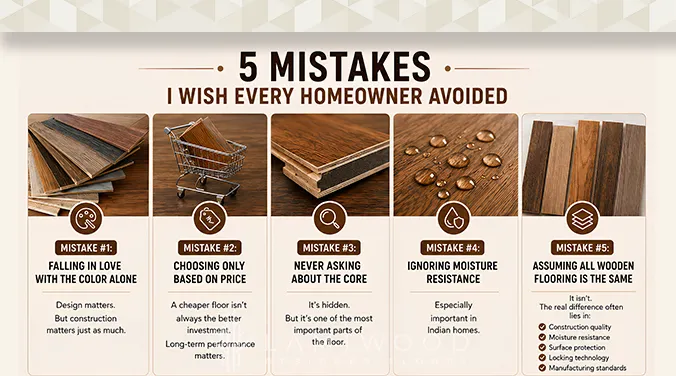
Mistake #1: Falling in Love with the Color Alone
Design matters.
But construction matters just as much.
Mistake #2: Choosing Only Based on Price
A cheaper floor isn't always the better investment.
Long-term performance matters.
Mistake #3: Never Asking About the Core
It's hidden.
But it's one of the most important parts of the floor.
Mistake #4: Ignoring Moisture Resistance
Especially important in Indian homes.
Mistake #5: Assuming All Wooden Flooring Is the Same
It isn't.
The real difference often lies in:
- Construction quality
- Moisture resistance
- Surface protection
- Locking technology
- Manufacturing standards
Read Also: Ultimate Guide to Choosing the Perfect Wooden Floors
Your 5-Minute Wooden Flooring Checklist
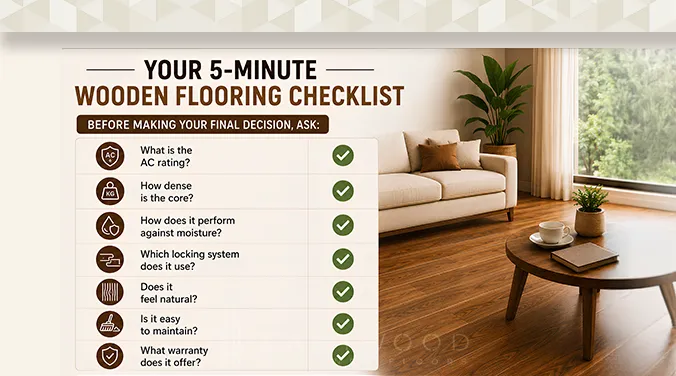
Before making your final decision, ask:
✅ What is the AC rating?
✅ How dense is the core?
✅ How does it perform against moisture?
✅ Which locking system does it use?
✅ Does it feel natural?
✅ Is it easy to maintain?
✅ What warranty does it offer?
If you get clear answers to these questions, you're already making a smarter flooring decision.
Final Thoughts: Ask One Question Before You Buy
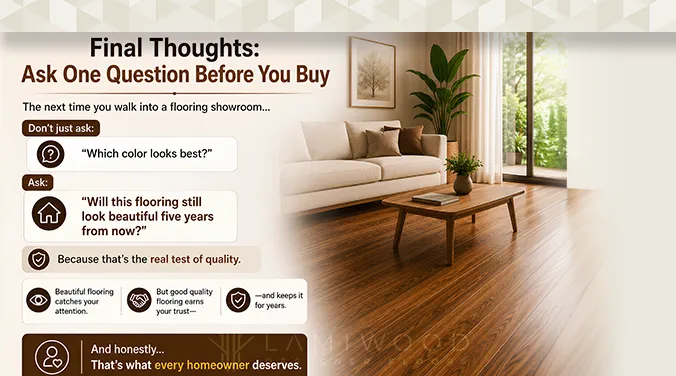
The next time you walk into a flooring showroom...
Don't just ask:
"Which color looks best?"
Ask:
"Will this flooring still look beautiful five years from now?"
Because that's the real test of quality.
Beautiful flooring catches your attention.
But good quality flooring earns your trust—and keeps it for years.
And honestly...
That's what every homeowner deserves.
Frequently Asked Questions
Look at the AC rating, core density, moisture resistance, locking system, texture, and warranty before making a decision.
Check the AC rating, core construction, moisture resistance, locking system, warranty, and maintenance requirements.
The best AC rating depends on your lifestyle and foot traffic. AC3, AC4, and AC5 are all suitable for different applications.
Good quality flooring is designed to offer better stability and moisture resistance, helping it perform well in humid conditions.
Its lifespan depends on the product quality, usage, and maintenance. Choosing the right flooring for your needs can provide long-lasting performance.
For a free consultation, reach out at 91+9999500117 Or drop us an email at [email protected]