


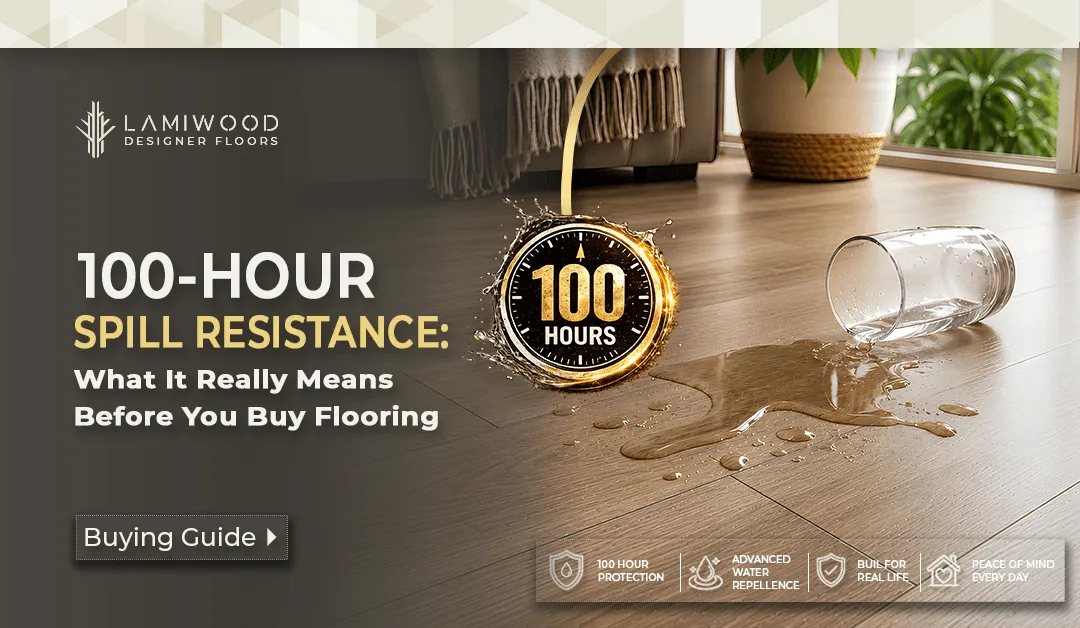
More than a marketing claim. Here's what it actually means for your home.
A 100-hour spill resistance claim means the flooring has been engineered to resist moisture from accidental spills for an extended period under defined conditions. It does not mean the flooring is waterproof, nor does it mean spills should be left unattended.
Think of it as an added margin of protection for everyday life, not permission to ignore maintenance.
Before buying any flooring, remember these four points:
- Spill-resistant flooring is different from waterproof flooring.
- Promptly cleaning spills is always the best practice.
- Long-term performance depends on the entire flooring system, not one specification.
- Core quality, locking technology, installation, and maintenance all influence how well flooring performs over time.
Before You Read Further
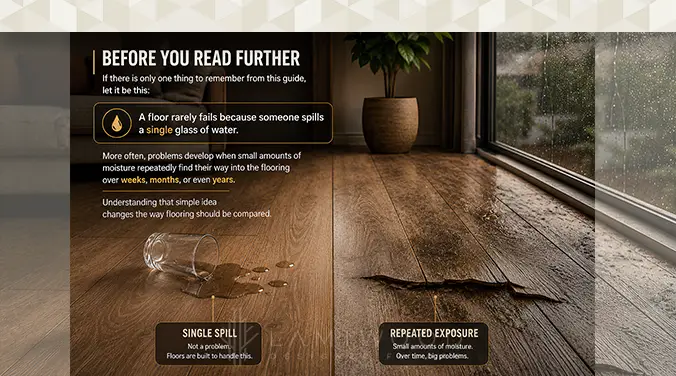
If there is only one thing to remember from this guide, let it be this:
A floor rarely fails because someone spills a single glass of water. More often, problems develop when small amounts of moisture repeatedly find their way into the flooring over weeks, months, or even years.
Understanding that simple idea changes the way flooring should be compared.
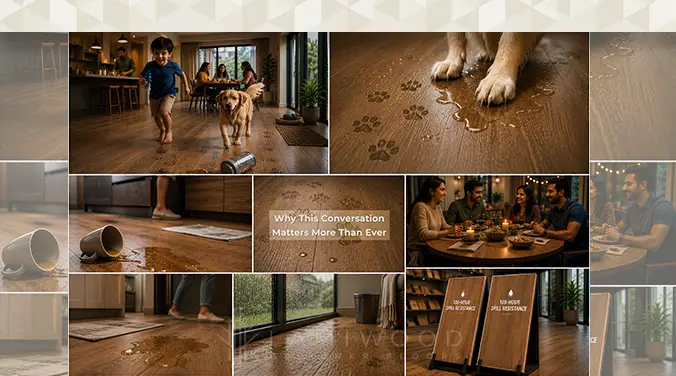
Why This Conversation Matters More Than Ever
Homes have changed.
A decade ago, flooring was often chosen almost entirely for its appearance.
Today, expectations are different.
Modern flooring isn't expected to look good only on the day it's installed.
It needs to perform through everyday life.
That includes:
- Children running through the house with water bottles.
- Pets leaving wet paw prints after a walk.
- Friends gathering for dinner.
- Busy mornings when spills aren't noticed immediately.
- Rainy afternoons during the monsoon.
None of these moments is unusual.
They're simply part of living in a real home.
Good flooring isn't designed for perfect conditions.
It's designed for everyday ones.
Did You Know?
Many flooring-related moisture problems begin with small, repeated exposure rather than one major accident.
For example, a damp doormat near the entrance during the rainy season may expose the same section of flooring to moisture every day. Over time, that repeated exposure can have a greater impact than a single spill that is cleaned immediately.
The Biggest Misunderstanding About 100-Hour Spill Resistance
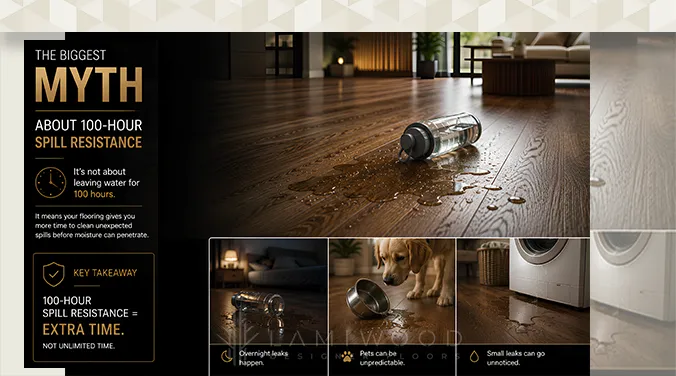
The number itself often creates confusion.
When people hear "100 hours," they naturally focus on the time.
In reality, the number isn't encouraging anyone to leave water sitting on the floor for four days.
It's communicating something much more important.
The flooring has been engineered to delay the movement of moisture, giving homeowners valuable extra time when unexpected situations occur.
That's a significant difference.
Life doesn't always allow immediate action.
Sometimes a water bottle leaks while everyone is asleep.
Sometimes a pet knocks over its bowl just before the family leaves for work.
Sometimes a small appliance develops a slow leak that isn't discovered until the next morning.
These are exactly the situations spill resistance is intended to help with.
Not because accidents should be ignored.
But accidents don't always happen at convenient times.
Key Takeaway
The value of spill resistance is measured by the extra time it provides when life becomes unpredictable, not by how long water can remain on the floor.
A Home Doesn't Need Perfect Conditions. It Needs Practical Flooring.
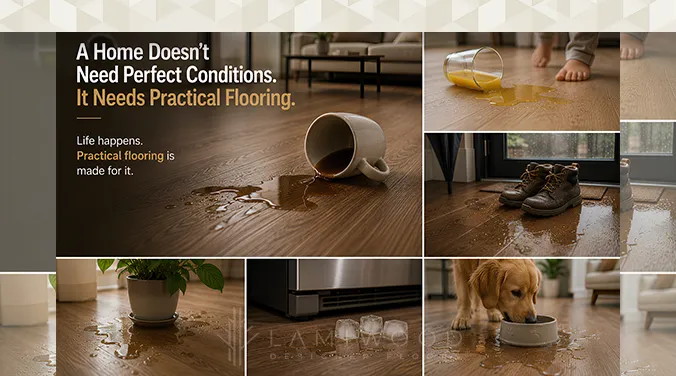
Think about the last month.
Chances are at least one of these situations happened:
- Someone spilled tea or coffee.
- A child dropped juice.
- Wet shoes came indoors after the rain.
- A flower pot leaked after watering.
- Ice cubes melted beside the refrigerator.
- A pet splashed water while drinking.
Most homeowners don't remember these moments because they are cleaned up and life moves on.
The flooring, however, experiences every one of them.
Over years of use, those small moments become part of the floor's story.
That is why performance matters just as much as appearance.
Expert Tip
When comparing flooring products, avoid making a decision based on one headline feature.
Instead, ask how the flooring has been engineered as a complete system.
A floor's long-term performance depends on several elements working together, including the core, locking system, surface protection, manufacturing precision, installation quality, and ongoing maintenance.
Looking at the complete picture almost always leads to a better buying decision
Why One Number Never Tells the Whole Story
Imagine buying a car based only on its fuel efficiency.
Fuel economy is important.
But it doesn't tell you anything about safety, comfort, reliability, braking performance, or maintenance costs.
Flooring works in much the same way.
A spill-resistance claim is one useful piece of information.
It should never be the only one.
Good flooring is the result of thoughtful engineering rather than one impressive specification.
Understanding how those different elements work together is what separates an informed buyer from someone choosing purely on marketing language.
And that's where the conversation becomes truly interesting.
Because the real story isn't happening on the surface of the floor.
It's happening beneath it.
What's Coming Next?
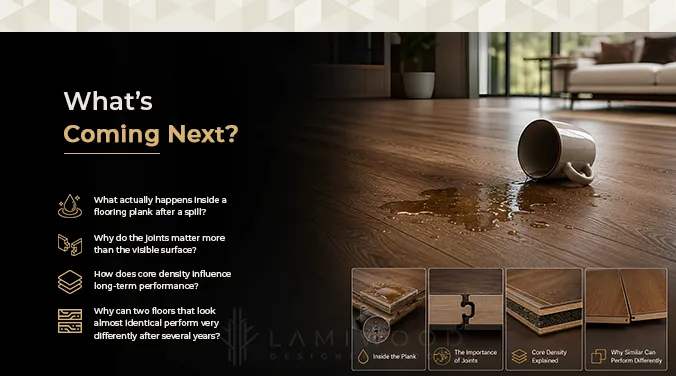
Now that the purpose of spill resistance is clear, it's time to answer the questions that most homeowners never think to ask:
- What actually happens inside a flooring plank after a spill?
- Why do the joints matter more than the visible surface?
- How does core density influence long-term performance?
- Why can two floors that look almost identical perform very differently after several years?
The answers to these questions reveal why good flooring is about much more than appearance.
They reveal the engineering hidden beneath every plank.
What Really Happens After Water Touches Your Floor?
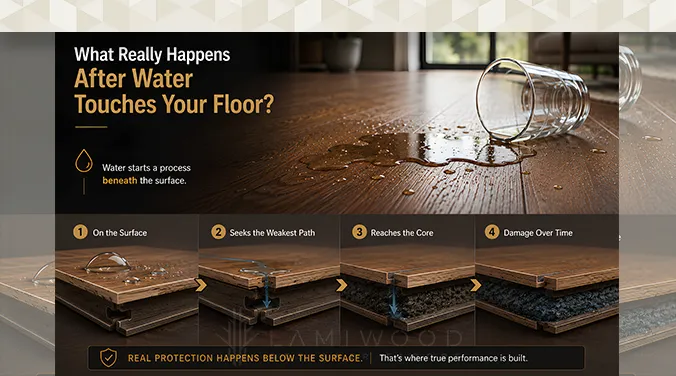
At first glance, a flooring plank looks surprisingly simple.
There's a decorative wood pattern on top.
A protective surface.
A few grooves along the edges.
That's almost all most people ever see.
What remains hidden is the engineering underneath.
Ironically, that's where the most important work happens.
Every time water touches the floor, a quiet process begins.
Whether that moisture causes lasting damage depends largely on what happens beneath the surface.
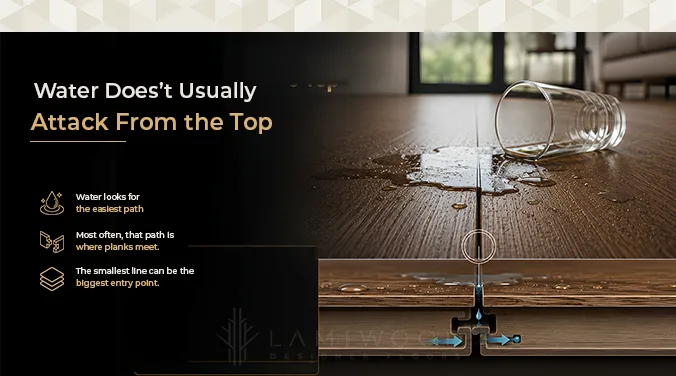
Water Doesn't Usually Attack From the Top
This surprises many homeowners.
When a glass of water is spilled, most people imagine the liquid soaking directly through the middle of the plank.
In reality, that's rarely the first place moisture tries to enter.
Instead, water behaves exactly as expected.
It looks for the easiest path.
Most often, that path is found where two flooring planks meet.
Think about the tiny line separating one plank from the next.
It may appear almost invisible.
Yet that's the point where moisture has the greatest opportunity to travel if it remains on the floor long enough.
Flooring Fact
The decorative surface is designed to help protect the flooring.
The joints between planks deserve just as much attention because they often become the first point of moisture exposure.
A Simple Way to Picture It
Imagine rain falling onto the roof of a house.
The roof tiles protect most of the surface.
If there's a small opening between two tiles, however, that's where water naturally tries to go.
Flooring behaves similarly.
The surface offers protection.
The joints require careful engineering.
That is why the quality of the locking system matters so much.
Why the Locking System Deserves More Attention
Most buyers compare colour.
Some compare prices.
Others compare thickness.
Very few ask about the locking system.
Yet it quietly influences how the flooring performs year after year.
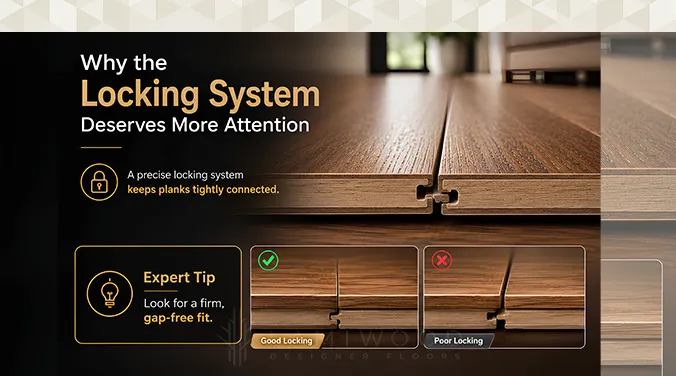
A locking system has one primary job.
It keeps neighbouring planks tightly connected.
When the fit is precise, there are fewer opportunities for moisture to work its way between the boards.
When the fit is poor, even a beautiful floor can become more vulnerable over time.
Know more: Valinge vs Uniclic vs Tongue & Groove Locking System: Pros, Cons, and Key Differences
Expert Tip
Ask to see how two sample planks connect before making a decision.
A good locking system should create a firm, accurate fit without visible gaps.
It's one of the easiest ways to understand the quality of the flooring beyond its appearance.
The Hidden Role of the Core
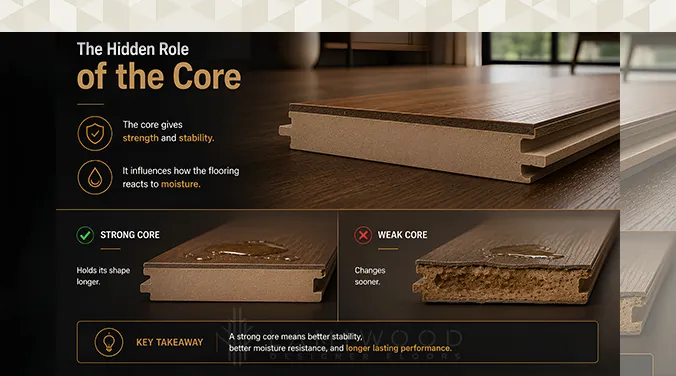
If the surface is the flooring's first line of defence, the core is its foundation.
The core gives every plank its strength and stability.
It also influences how the flooring reacts when exposed to moisture.
Imagine two notebooks.
One has thick, tightly pressed pages.
The other is made from soft paper.
Accidentally spill water on both.
The thicker pages usually hold their shape longer.
The softer pages begin changing much sooner.
Flooring cores respond similarly.
Although no comparison is perfect, it helps explain why core quality plays such an important role in long-term performance.
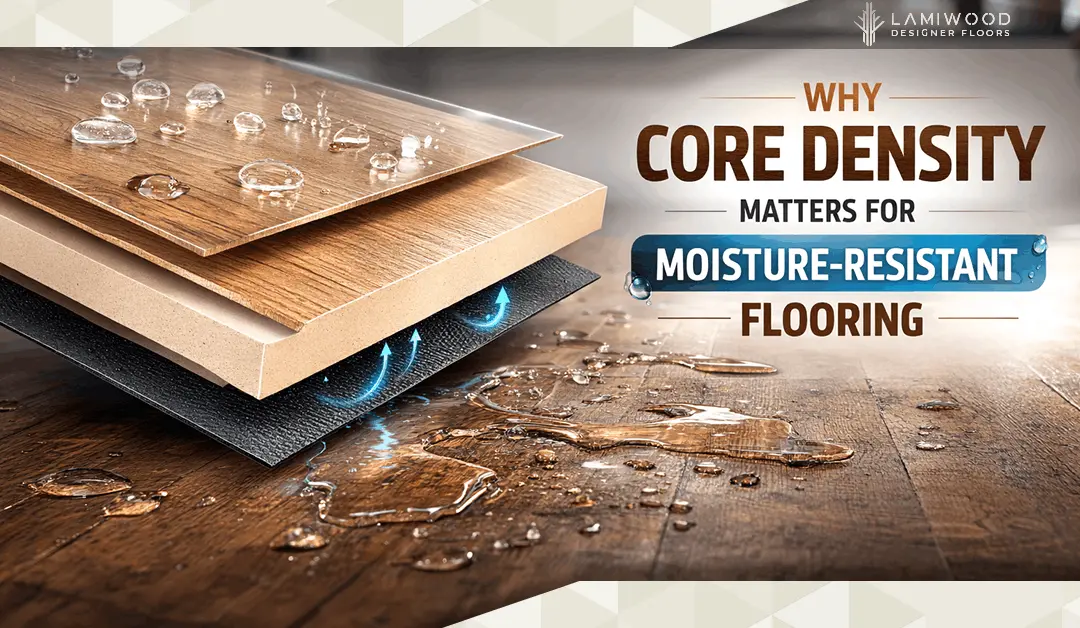
Know more: Why Core Density Matters for Moisture-Resistant Flooring
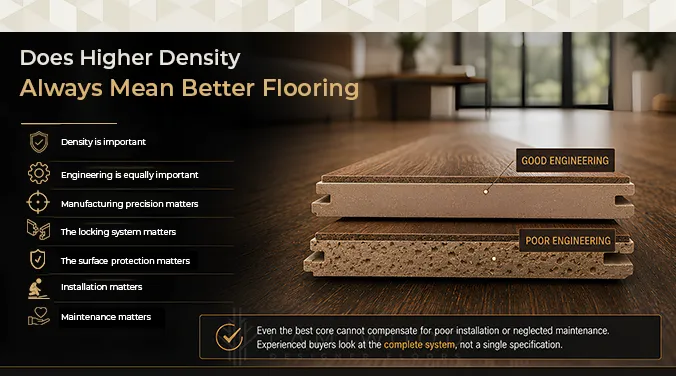
Does Higher Density Always Mean Better Flooring?
Not necessarily.
Density is important.
Engineering is equally important.
Manufacturing precision matters.
The locking system matters.
The surface protection matters.
Installation matters.
Even the best core cannot compensate for poor installation or neglected maintenance.
This is why experienced buyers avoid judging flooring using a single specification.
They look at the complete system.
Know more: High-Density Core Floors Outperform the Competition
Did You Know?
Two flooring products can appear almost identical in a showroom while performing very differently after several years of everyday use.
Many of those differences remain invisible until the flooring has experienced changing seasons, daily foot traffic, and repeated exposure to moisture.
Good engineering often stays hidden.
Its value becomes obvious only with time.
Why Small Spills Can Become Bigger Problems
Imagine placing a few drops of water on a kitchen counter.
Nothing happens.
Now imagine placing the same few drops in the same place every day for several months.
The result is very different.
Flooring behaves in much the same way.
One spill that is cleaned quickly rarely causes concern.
Repeated moisture in the same location deserves far more attention.
This is why areas near entrances, kitchen sinks, refrigerators, balconies, and dining tables often experience greater wear than other parts of the home.
It's not because these rooms are poorly designed.
It's because everyday habits expose them to moisture more frequently.
Common Mistake
Many homeowners worry about dramatic accidents.
Far fewer think about the small amounts of moisture that quietly return to the same spot every day.
Over time, repeated exposure usually matters more than isolated incidents.
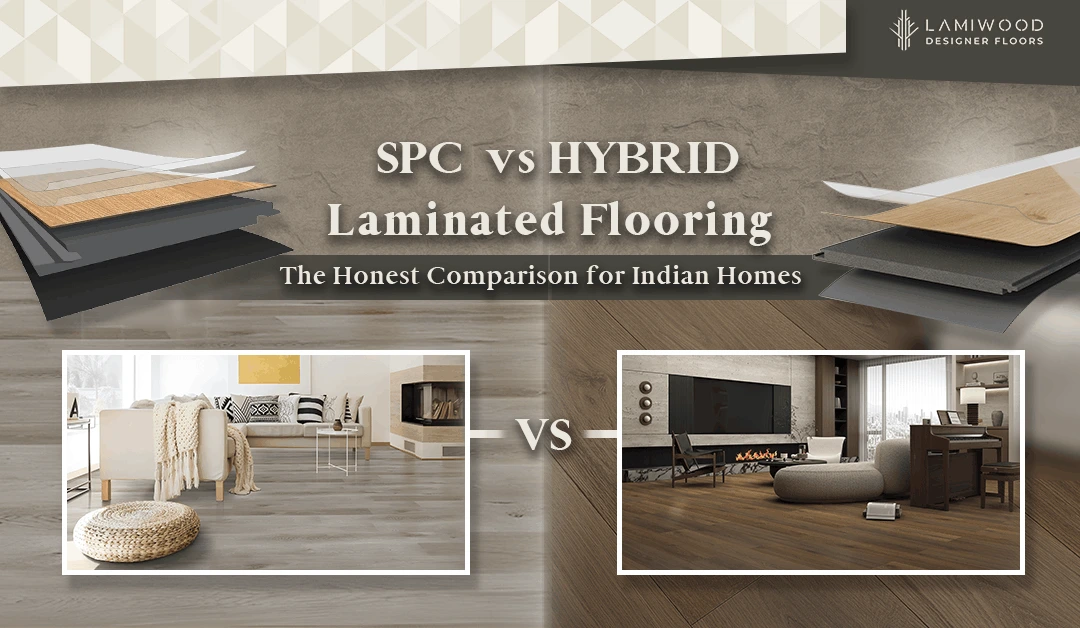
Know more: Hybrid Laminate Flooring: A Smart, Lasting Investment
Why This Matters in Indian Homes
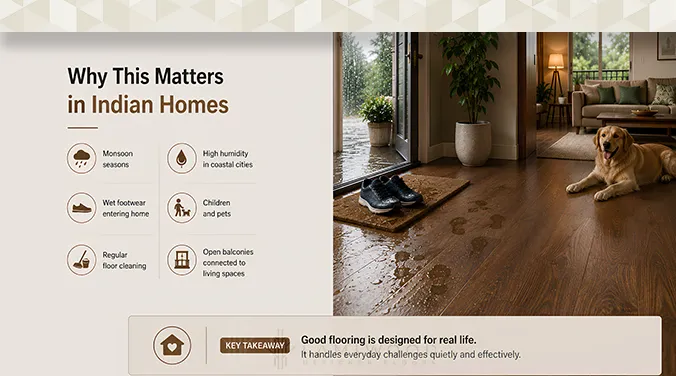
Every country presents different challenges for flooring.
Indian homes often experience conditions that make moisture resistance especially relevant.
These include:
- Long monsoon seasons in many regions.
- Wet footwear entering the home.
- Regular floor cleaning.
- High humidity in coastal cities.
- Busy households with children and pets.
- Open balconies connected to living spaces.
None of these conditions is unusual.
They simply reflect the way homes are used.
Choosing flooring without considering these everyday realities is a little like buying a raincoat based only on its colour.
Appearance matters.
Performance matters even more.
Key Takeaway
Good flooring isn't designed for ideal conditions.
It's designed for real life.
That means handling the small, everyday challenges that every home experiences, often without anyone even noticing.
Before Moving On...
By now, one thing should be clear.
A 100-hour spill resistance claim isn't really about a number.
It's about engineering.
The surface.
The joints.
The locking system.
The core.
The manufacturing precision.
All of these work together to help slow the movement of moisture.
But engineering is only part of the story.
The way a floor is used every day is equally important.
In the next section, the focus shifts from the flooring itself to the people living on it.
Because even the best-engineered floor can perform very differently depending on the household's habits.
That's where the biggest myths, the most common mistakes, and the smartest buying decisions begin.
Good Flooring Is Only Half the Story. The Rest Depends on Everyday Habits
By now, it's clear that spill-resistant flooring isn't about performing miracles.
It's about providing an extra layer of confidence when everyday accidents happen.
But here's something that rarely appears in product brochures.
Even the best-engineered flooring can't compensate for poor habits.
The way a floor is used every day has a surprisingly large influence on how it looks and performs years later.
Fortunately, most of these habits are simple to improve.
The Small Things Usually Matter Most
When people imagine flooring damage, they often picture dramatic situations.
A burst pipe.
A flooded room.
A major plumbing leak.
While those events certainly deserve attention, they are relatively uncommon.
The reality is much less dramatic.
Most flooring experiences hundreds of tiny interactions every single day.
A few drops of water near the sink.
Wet shoes after an evening shower.
A pet's water bowl.
A damp mop.
A flower pot that slowly leaks.
Each event seems insignificant on its own.
Together, they shape the long-term condition of the floor.
Know more: How To Clean Wooden Flooring: Expert Tips
Flooring Fact
Long-term flooring performance is often influenced more by daily habits than by occasional accidents.
Small actions repeated over several years usually have a greater impact than one unexpected spill that is cleaned promptly.
The Most Common Mistakes Homeowners Make
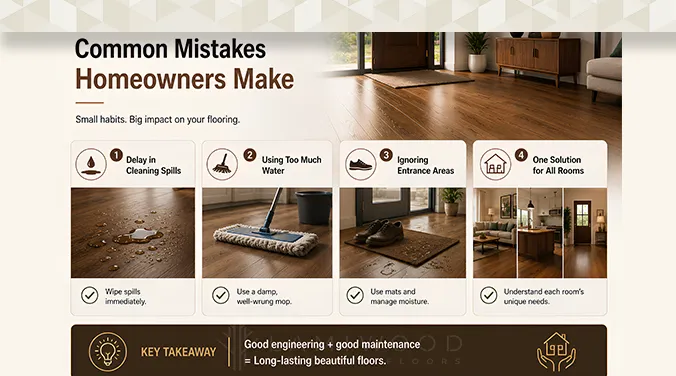
Choosing quality flooring is only the first step.
Keeping it looking its best depends on how it's cared for.
Here are some of the most common mistakes that reduce the life of any flooring, including spill-resistant products.
Mistake 1: Waiting Too Long to Clean a Spill
It's easy to think,
"I'll clean that in a few minutes."
Sometimes that turns into an hour.
Sometimes it turns into the next morning.
The longer moisture remains in one place, the more opportunity it has to work its way into the joints.
Better Practice
✔ Wipe spills as soon as they're noticed.
✔ Use a soft, absorbent cloth.
✔ Allow the area to dry naturally after cleaning.
Mistake 2: Using Too Much Water During Cleaning
Many homeowners believe a wetter mop means a cleaner floor.
In reality, excessive water can expose the flooring to unnecessary moisture every time it's cleaned.
Better Practice
- Use a well-wrung damp microfiber mop.
- Avoid leaving standing water behind.
- Follow the cleaning recommendations provided by the flooring manufacturer.
Mistake 3: Forgetting About Entrance Areas
The entrance experiences some of the toughest conditions in the home.
Dust.
Grit.
Moisture.
Wet footwear.
During the rainy season, this area can remain damp for extended periods if it isn't managed properly.
Better Practice
- Use high-quality entrance mats.
- Allow wet footwear to dry whenever possible.
- Lift mats regularly so moisture doesn't remain trapped underneath.
Mistake 4: Assuming Every Room Has the Same Needs
Every room places different demands on flooring.
A formal living room experiences very different conditions from a kitchen or an entrance foyer.
Understanding how each space is used helps in selecting the most suitable flooring for that environment.
Key Takeaway
Good flooring performs best when good engineering is supported by good maintenance.
Neither works as effectively without the other.
Does Spill Resistance Matter More for Families?
In many cases, yes.
Family homes are naturally more active.
Children rarely think about protecting the floor.
Nor should they.
They're busy playing, learning, and exploring.
That means everyday accidents become part of family life.
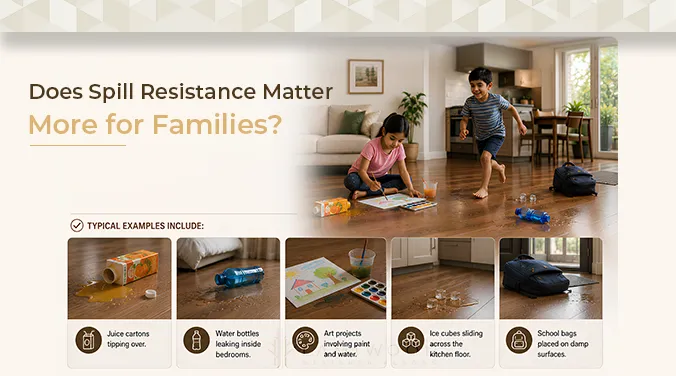
Typical examples include:
- Juice cartons tipping over.
- Water bottles are leaking inside bedrooms.
- Art projects involving paint and water.
- Ice cubes are sliding across the kitchen floor.
- School bags are being placed on damp surfaces.
These moments aren't signs of carelessness.
They're signs of a home being lived in.
A floor should be chosen with those realities in mind.
What About Homes With Pets?
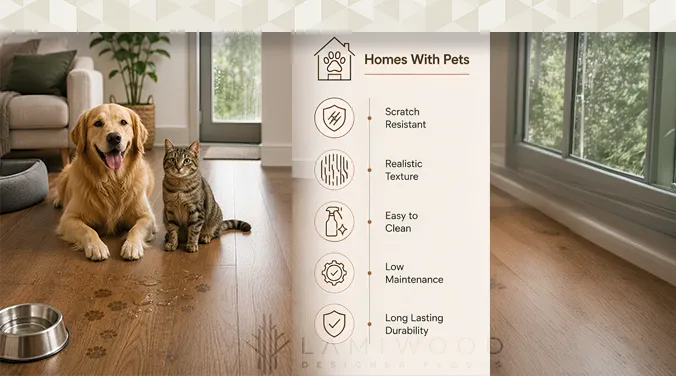
Pets add another layer to everyday life.
Water bowls.
Wet paws.
Excited greetings at the front door after a rainy walk.
Occasional accidents.
None of these situations is unusual.
The goal isn't to find flooring that never requires care.
The goal is to choose flooring that's better prepared for the realities of sharing a home with animals.
Know more: The Best Flooring Choice for Homes with Pets: Top Picks
Expert Tip
When choosing flooring for a home with pets, don't focus only on spill resistance.
Also consider:
- Scratch resistance
- Surface texture
- Ease of cleaning
- Maintenance requirements
- Long-term durability
Looking at these features together provides a much clearer picture of everyday performance.
Five Questions Nobody Asks Before Buying Flooring
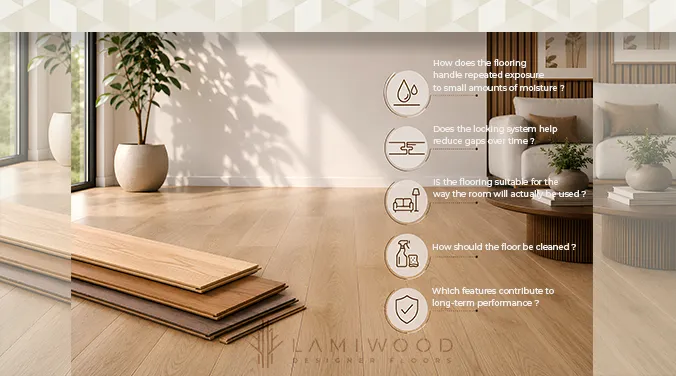
Most buyers ask about colour.
Price.
Warranty.
Thickness.
Very few ask questions that reveal how the flooring will perform after five or ten years.
These questions are worth asking.
1. How does the flooring handle repeated exposure to small amounts of moisture?
One major spill is uncommon.
Small spills happen every week.
2. Does the locking system help reduce gaps over time?
The quality of the connection between planks influences long-term performance.
3. Is the flooring suitable for the way the room will actually be used?
A guest bedroom and a family kitchen rarely need the same flooring solution.
4. How should the floor be cleaned?
Maintenance should be simple enough to become part of everyday life.
5. Which features contribute to long-term performance?
Look beyond one headline claim.
Consider the flooring as a complete system.
Buyer Tip
Whenever possible, compare flooring samples side by side.
Instead of asking,
"Which one looks better?"
Ask,
"Which one is likely to perform better five years from now?"
That small shift in thinking often leads to a much better decision.
Why Indian Homes Deserve a Different Conversation
Much of the flooring advice available online comes from countries with very different climates.
Indian homes often experience unique challenges.
These include:
- Long monsoon seasons.
- High humidity in many regions.
- Dust carried indoors.
- Frequent floor cleaning.
- Multi-generational households with constant activity.
- Indoor-outdoor living spaces such as balconies and terraces.
Choosing flooring without considering these conditions means overlooking an important part of everyday life.
The best flooring isn't simply the one with the most impressive brochure.
It's the one that's designed for the environment in which it will actually be used.
Common Mistake
Choosing flooring based only on appearance.
Beautiful flooring attracts attention on the day it's installed.
Well-engineered flooring continues earning appreciation years later.
The difference often isn't visible in a showroom.
It becomes visible through everyday living.
Before Moving to the Final Section...
By now, the picture is becoming much clearer.
A 100-hour spill resistance claim isn't a promise that accidents don't matter.
It's an indication that the flooring has been engineered to respond better when they do.
The final part of this guide brings everything together.
It answers the most common questions homeowners still have, provides a practical buying checklist, and explains how to compare flooring with confidence instead of relying on marketing language.
Know more: Ultimate Guide to Choosing the Perfect Wooden Floors
Making a Smarter Flooring Decision Starts With Asking Better Questions
By now, one thing should be clear.
Choosing flooring isn't about finding the product with the biggest number on the packaging.
It's about understanding what that number actually means.
A 100-hour spill resistance claim is valuable when it's supported by good engineering, proper installation, and sensible maintenance.
Viewed in isolation, however, it tells only part of the story.
The best buying decisions come from looking at the complete picture.
Six Questions to Ask Before Buying Any Spill-Resistant Flooring
Walking into a showroom without knowing what to ask can make every product sound equally impressive.
Instead of focusing only on the marketing brochure, use these questions to guide the conversation.
1. What Makes This Flooring Spill Resistant?
Ask the salesperson to explain how the flooring achieves its performance.
The answer should include information about its construction, not just the claim itself.
2. What Type of Core Does It Use?
The core is one of the most important parts of any flooring plank.
Understanding its construction provides a better indication of long-term performance than looking only at the surface.
3. Which Locking System Has Been Used?
The locking system influences how securely the planks fit together.
A precise connection helps reduce the opportunity for moisture to enter through the joints.
4. What Cleaning Method Is Recommended?
A quality floor should be easy to maintain.
Following the manufacturer's care instructions helps preserve both appearance and performance.
5. What Does the Warranty Actually Cover?
Instead of asking only about the warranty period, ask what situations are included and what conditions apply.
A clear understanding today can prevent misunderstandings later.
6. Is This Flooring Suitable for My Lifestyle?
Every home is different.
A retired couple, a growing family, and a pet owner all have different expectations from their flooring.
The right product is the one that matches the way the home is actually lived in.
Know More: 6 Things To Consider Buying New Flooring
Buyer Checklist
Before making a final decision, use this simple checklist.
Construction
☐ Understand the flooring core.
☐ Ask about the locking system.
☐ Check the wear layer and surface protection.
Everyday Performance
☐ How does it handle accidental spills?
☐ Is it suitable for the room?
☐ Does it suit the local climate?
Long-Term Value
☐ Is the maintenance practical?
☐ Is the warranty easy to understand?
☐ Will the flooring still meet your needs several years from now?
If the answer to most of these questions is "yes," there's a much better chance of making a satisfying long-term investment.
Frequently Asked Questions
No.
Spill-resistant flooring is designed to better withstand accidental spills for a limited period under defined conditions.
Waterproof flooring is designed for environments where regular or prolonged water exposure is expected.
The two terms should never be used interchangeably.
Yes.
Standing water should always be removed as soon as possible.
Spill resistance provides extra time, not unlimited protection.
Not necessarily.
Flooring performance depends on several factors working together, including:
Core quality
Locking system
Surface protection
Manufacturing precision
Installation quality
Maintenance
Looking at only one specification rarely provides the full picture.
In many homes, yes.
Kitchens often experience occasional spills rather than continuous standing water.
Always choose flooring according to the manufacturer's recommendations and the intended application.
Know more: Wooden Flooring for Kitchens and Bathrooms
What About Bathrooms?
Bathrooms experience frequent moisture, splashing, and standing water.
Unless a flooring product has been specifically approved for bathroom installation, selecting a more suitable flooring solution is generally advisable.
Does Good Installation Really Make a Difference?
Absolutely.
Even high-quality flooring performs best when installed correctly.
A well-prepared subfloor, accurate plank alignment, and proper expansion gaps all contribute to long-term performance.
Know more: How to Install Wooden Flooring: A Complete Guide
The Bigger Lesson
There was a time when choosing flooring meant comparing colours and finishes.
Today, homeowners have access to much more information.
That's a good thing.
But it also means marketing claims can sometimes become the centre of the conversation.
They shouldn't be.
A floor is more than a specification sheet.
It's a surface that quietly supports everyday life.
Children learn to walk on it.
Families gather around it.
Pets race across it.
Furniture stays in place for years.
Thousands of footsteps become part of its story.
The best flooring isn't simply beautiful on installation day.
It continues looking and performing well through ordinary moments that no brochure ever shows.
Imagine This...
Two neighbours renovate their homes at roughly the same time.
Both choose flooring with a similar wood finish.
Both are pleased with how it looks.
Five years later, the floors tell different stories.
One still looks stable and well-maintained despite the occasional spill, rainy season, and everyday family life.
The other has started showing signs of wear around entrances and frequently used areas.
At first glance, both choices looked equally good.
The difference wasn't visible in the showroom.
It was hidden inside the flooring itself, in the quality of its engineering, the way it was installed, and the way it was cared for over time.
That's why informed decisions matter.
Not because they make shopping more complicated.
Because they help avoid disappointment years later.
Key Takeaways
Before leaving this guide, remember these six points.
- Spill resistance and waterproofing are different.
- Flooring joints deserve as much attention as the visible surface.
- Core quality and locking technology influence long-term performance.
- Promptly cleaning spills remains the best way to protect any flooring.
- Everyday habits have a greater impact than many homeowners realise.
- Choosing flooring should always be based on how the home will actually be used.
Final Thoughts
A 100-hour spill resistance claim isn't really about 100 hours.
It's about giving homeowners greater confidence when everyday accidents happen.
It's the reassurance that an unexpected spill doesn't immediately become an expensive problem.
It's the understanding that thoughtful engineering can provide valuable extra time when life becomes busy.
At the same time, it's important to remember that no flooring is completely maintenance-free.
No technical feature replaces sensible care.
No specification removes the need for proper installation.
And no single number can describe the overall quality of a floor.
The best flooring decisions are rarely made by comparing marketing claims alone.
They're made by understanding how different features work together to support everyday living.
The next time a flooring brochure highlights spill resistance, look beyond the headline.
Ask what it means.
Ask how it works.
Ask how it fits your lifestyle.
Those questions often lead to better decisions than any specification printed on the packaging.
Because in the end, the most valuable flooring isn't the one with the most impressive claim.
It's the one that continues performing beautifully long after the excitement of installation day has passed.
For a free consultation, reach out at 91+9999500117 Or drop us an email at [email protected]